Table Of Content
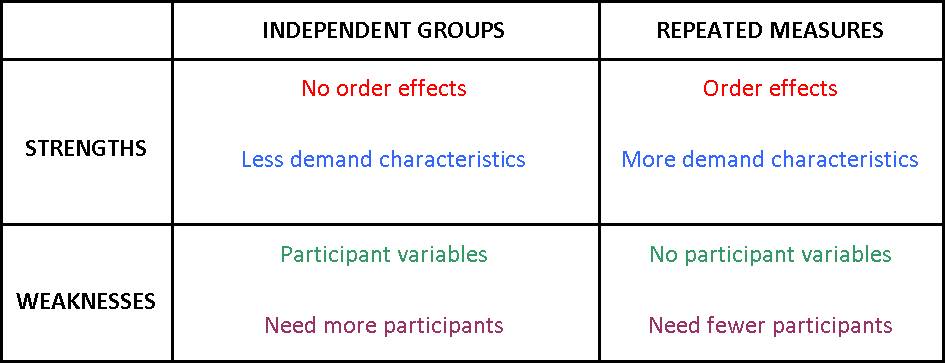
Because I believe it is critically important for the state of MT research to improve, I highlight these flaws. Between subjects designs are invaluable in certain situations, and give researchers the opportunity to conduct an experiment with very little contamination by extraneous factors. Every experimental group is given an independent variable treatment that the researcher believes will have some effect on the outcomes, while control groups are given no treatment, a standard unrelated treatment, or a fake treatment. The other group is called the experimental group, which receives the treatment of the study. It is possible to have more than two groups and several treatments but the minimum for between group designs is two groups. The hypothetical experiment involves children, and we must first generate a sample of child participants.
Matched Groups
But it could be instead that they judge him more harshly because they are becoming bored or tired. The attractive condition is always the first condition and the unattractive condition the second. Thus any difference between the conditions in terms of the dependent variable could be caused by the order of the conditions and not the independent variable itself. Between-subjects and within-subjects designs can be combined in a single study when you have two or more independent variables (a factorial design).
Within-Subjects Experiments
If the groups differ significantly, you can conclude that your independent variable manipulation likely caused the differences. In experiments, you test the effect of an independent variable by creating conditions where different treatments (e.g. a placebo pill vs a new medication) are applied. In this repeated-measures, or within-subjects design, potential confounds and the amount of error due to natural variance are automatically controlled for because the same participants are in each group.
5: Between Subject Designs
For each experiment, identify (1) which experimental design was used; and (2) why the researcher might have used that design. We expect the participants to learn better in “no noise” because of order effects, such as practice. Probably the most common way to design an experiment in psychology is to divide the participants into two groups, the experimental group and the control group, and then introduce a change to the experimental group, not the control group. Differences between subjects within a given condition may be an explanation for results, introducing error and making the effects of an experimental condition less accurate. Presumably, Hernandez-Reif et al. have scientifically grounded reasons to disagree with the results of those quantitative reviews.
In a within-subject design, each participant experiences all experimental conditions, whereas, in a between-subject design, different participants are assigned to each condition, with each experiencing only one condition. All variables which are not independent variables but could affect the results (DV) of the experiment. A matched pairs design is an experimental design where pairs of participants are matched in terms of key variables, such as age or socioeconomic status. One member of each pair is then placed into the experimental group and the other member into the control group. This design allows researchers to examine the individual effects of each independent variable and their interaction effect on the dependent variable, while each participant is exposed to only one combination of conditions. In a mixed factorial design, researchers will manipulate one independent variable between subjects and another within subjects.
Popular Psychology Terms
For example, let’s say you have some corn plants and you want to see if the fertilizer you bought makes any difference.in the amount of corn produced. You divide the corn plants into two groups, one that receives the fertilizer (experimental group), and one that does not (controlled group). You apply the fertilizer to the control group and after a period of time, you measure the amount of corn produced.
What’s the difference between a within-subjects versus a between-subjects design?
However, too often in MT research the appearance of a new randomized control trial is a mixed blessing, or even a missed opportunity. This is because randomized control trials of MT frequently have major flaws (1,2), including the failure to accurately review previous findings and the failure to follow the logic of their own research design. I was reacquainted with these persistent flaws when I read Hernandez-Reif et al.'s (3) recent report in this journal on the effects of MT on Dominican children with HIV.
Individual differences may threaten validity

The pretest is similar to a control condition where no independent variable treatment is given yet, while the posttest takes place after all treatments are administered. This practise violates the logic of using randomization to create treatment and control groups, and thereby fails to control for the validity threats of spontaneous remission, placebo effects, and statistical regression. The result is that a clear understanding of what MT can and cannot do is seriously hampered. The primary advantage of this approach is that it provides maximum control of extraneous participant variables.
Then, you would administer the same test to all participants and compare test scores between the groups. Then, you compare the percentage of newsletter sign-ups between the two groups using statistical analysis. The and second groups are experimental groups and the second and fourth groups are control groups. In summary, because we cannot test all of the fourth graders in a city, we want to find a group of about 200 that reflects the composition of that city.
If the fertilized corn produces more you can infer that it is because of the fertilizer. A true experiment is one in which the participants are randomly assigned to different groups. In a quasi-experiment, the researcher is not able to randomly assigned participants to different groups.
Algorithmic bias detection and mitigation: Best practices and policies to reduce consumer harms Brookings - Brookings Institution
Algorithmic bias detection and mitigation: Best practices and policies to reduce consumer harms Brookings.
Posted: Tue, 27 Jun 2023 03:11:20 GMT [source]
The best method of counterbalancing is complete counterbalancing in which an equal number of participants complete each possible order of conditions. For example, half of the participants would be tested in the attractive defendant condition followed by the unattractive defendant condition, and others half would be tested in the unattractive condition followed by the attractive condition. With three conditions, there would be six different orders (ABC, ACB, BAC, BCA, CAB, and CBA), so some participants would be tested in each of the six orders. With four conditions, there would be 24 different orders; with five conditions there would be 120 possible orders. With counterbalancing, participants are assigned to orders randomly, using the techniques we have already discussed.
One can analyze the data separately for each order to see whether it had an effect. Consider an experiment on the effect of a defendant’s physical attractiveness on judgments of his guilt. Again, in a between-subjects experiment, one group of participants would be shown an attractive defendant and asked to judge his guilt, and another group of participants would be shown an unattractive defendant and asked to judge his guilt. In a within-subjects experiment, however, the same group of participants would judge the guilt of both an attractive and an unattractive defendant. In a within-subjects design, each participant experiences all conditions, and researchers test the same participants repeatedly for differences between conditions.
With a representative group, we can generalize our findings to the larger population without fear of our sample being biased in some way. Within-subjects are typically used for longitudinal studies or observational studies conducted over an extended period. The variable the experimenter manipulates (i.e., changes) is assumed to have a direct effect on the dependent variable. At the end of this period, their reading was reassessed, and a reading improvement score was calculated. They were then taught using scheme two for a further 20 weeks, and another reading improvement score for this period was calculated. Julia Simkus is a graduate of Princeton University with a Bachelor of Arts in Psychology.
In contrast, in a within-subjects design, researchers will test the same participants repeatedly across all conditions. Between-subjects and within-subjects designs are two different methods for researchers to assign test participants to different treatments. After the patients were treated according to their assigned condition for some period of time, let’s say a month, they would be given a measure of depression again (post-test). This design would consist of one within-subject variable (test), with two levels (pre and post), and one between-subjects variable (therapy), with two levels (traditional and cognitive).
But if the study is between-subjects you will need twice as many to get the same number of data points. The choice of experimental design will affect the type of statistical analysis that should be used on your data. A 2×2 within-subjects design is one in which there are two independent variables each having two different levels. This design allows researchers to understand the effects of two independent variables (each with two levels) on a single dependent variable. It’s important to consider the pros and cons of between-subjects versus within-subjects designs when deciding on your research strategy.
For example, an average-looking defendant might be judged more harshly when participants have just judged an attractive defendant than when they have just judged an unattractive defendant. Within-subjects experiments also make it easier for participants to guess the hypothesis. An alternative to simple random assignment of participants to conditions is the use of a matched-groups design.




No comments:
Post a Comment